| Fijian Economy
Economy
Fiji is described as middle-income country and one of the more developed of the Pacific island economies, although it remains a developing country with a large subsistence agriculture sector. In 2012, Fiji's economy grew by 2.5%. For 2013, the Reserve Bank of Fiji officially forecasts a 2.7% growth rate to be driven by the agriculture, manufacturing and the financial intermediation sectors. This growth is expected to be felt broadly across the economy. The year-end 2012 inflation was just below 3 %.
For many years sugar and textile exports drove Fiji's economy. However, decline in preferential market access and the phasing out of a preferential price agreement with the European Union [to sugar price reductions of 36%] undermined earnings and the potential of these two sectors in becoming competitive in globalized markets. Increased Government investment into Fiji's sugar industry in the last 5 years is showing signs of addressing issues of quality concerns, poor administration and inefficiency in the industry. The Government-led industry reforms implemented from 2010 is now witnessing cane quality and sugar production level increasing.
In 2005, the textile industry in Fiji markedly declined following the end of the quota system under the Agreement on Textiles and Clothing (ATC) and the full integration of textiles into the World Trade Organization (WTO) General Agreement on Tariffs and Trade. The income from garments plummeted by 47% in 2005 with the end of the ATC quotas. Garments now account for around 9% of Fiji's exports and sugar approximately 20.9%. Other important export crops include coconuts, dalo, tropical fruits and ginger. Fiji has extensive mahogany timber reserves, which are being exploited. Fishing is an important export and local food source. From 2011, fish became one of the leading domestic export commodity. Gold from Fiji’s only gold mine is also an important export industry and is expected to continue its positive performance with rising gold prices.
From 2000 the export of still mineral water, mainly to the United States, had expanded rapidly. Water exports in 2010 were estimated at $119.2 million.
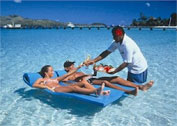
In recent years, growth in Fiji has been largely driven by a strong tourism industry. Tourism has expanded since the early 1980s and is the leading economic activity in the islands. About 40% of Fiji's visitors come from Australia, with large contingents also coming from New Zealand, the United States, the United Kingdom, and the Pacific Islands. Tourist arrivals grew by 7% in 2011 and reached the 680,000. Fiji's gross earnings from tourism in 2011 totaled $1.051 billion, more than the combined revenues of the country’s top five exports (fish, water, garments, timber, and gold).
Although tourism revenues yield a services surplus, Fiji runs a persistently large trade and current account deficit. The trade deficit in 2010 was around $1 billion. Australia accounts for between 25% and 35% of Fiji's foods trade, with New Zealand, Singapore, the United States, the United Kingdom, and Japan varying year-by-year between 5% and 20% each. Since the 1960s, Fiji has had a high rate of emigration, especially true of persons with education and skills seeking better economic opportunities abroad. The economic and political of 1987 and 2000 have also added to the outward flow by persons of all ethnic groups. Remittances from overseas workers, which grew 14% from January to May in 2010 compared with the same period in 2009, are second only to tourism as a source of foreign exchange earnings. The government's 2012 national budget proposed tax breaks for a reported 99% of Fijian citizens and reduced corporate taxes and tariffs on construction vehicles and production machinery, with these tax relief measures to be offset by an upper-income tax surcharge, enhanced revenue collection, and increased airport departure taxes.
For additional information on the Fiji economy the following websites are relevant:
Reserve Bank of Fiji - www.reservebank.gov.fj
Bureau of Statistics - www.investmentfiji.org.fj
|